Monday, January 16, 2012

Gaijin

The word means "outsider". Its use is often derogatory. It applies to me wherever I am.

I used to think that the distance I felt between myself and the rest of the world, the layers of numbness that separated us, lent me a degree of objectivity, that it made me a disinterested observer, and that this in turn would one day help me become the writer I wanted to be. And then there were the bad days... Of course, I had considered that maybe I was suffering from depression. Considered and dismissed it. Depressions was a serious condition and what I had was the occasional case of the blues. To even contemplate the two together was to denigrate the more serious condition. But then the bad days became more frequent, they lasted longer and the gaps between them grew shorter... And yet I continued ignoring it, year after year, until I finally had to admit — after ticking almost all the boxes on a couple of different "spot the signs" checklists — that maybe my problem had a name after all.

Travelling alone was probably a mistake, but I didn't really have much choice. I've always wanted to travel, but it wasn't until very recently that the opportunity — the confluence of money and spare time — presented itself. And of course I was alone, so if I wanted to travel I would have to do it — as I have to do everything — alone. But you're never really alone with depression, and so I found myself walking the streets of one of the greatest cities in the world, a black dog slinking along at my heels, close to tears at how wretched I felt.

I'm sure that there's an aphorism about travelling in order to discover yourself. I discovered that on the streets of Tokyo I was the same pathetic individual as I am in London. I shied away from so many of the new experiences there were to sample. I should have learnt more of the language before I went. I should have pressed harder against the boundaries of my comfort zones. Instead I cowered, ran away, hid. Every evening I was tucked up in my hotel room nice and early, telling myself that watching local TV was more in keeping with my goal of immersing myself in the culture of the place than would be sitting ignored in the corner of some bar. I never go out alone in London, either.

The worse thing is the lack of memories. I have copious photographs — which in due course I will sort through and post online — but that's not the same. They mean something only to me. I can share snapshots, but the original moments were shared with no one. I always carry a notebook with me — I hope it will help me become the writer I want to be — and I note down observations, thoughts and snippets I hope share in my writing someday, but that's not the same, either. There was no pointing out things to a companion; there will be no "do you remember...?"s in the years to come. But again, this is no different from London, either. Being alone is shit wherever you are.

Otaku

I'll probably have my geek card confiscated — or rather, my membership record deleted from the database because, c'mon, membership cards are kinda low-tech — but I really wasn't that impressed with Akihabara. I went looking for a nerd nirvana and all I found were Curry's-esque chain stores and the kind of little junk PC shops which I used to run, full of faded boxed software (physical media? please) and cartons of dirty used keyboards. I don't know what I expected — maybe Case buying some no-name Chinese copy of a Russian military console. (Which reminds me, I never got to visit a capsule hotel. Next visit.)

Of course, there's a very good chance that I took a wrong turning on my way out of the station and missed the really exciting stuff, but I guess the real problem is that modern technology is, basically, boring. Barring the occasional disruption — think touch screen phones, and that was almost five years ago this week — the trajectories of all the major technologies are known about and blogged to death months in advance of their rolling off the fabs, so the chances of stumbling across anything genuinely exciting among the minor speed bumps and storage hikes is next to zero.

Or maybe I'm just bitter about the way that the girls outside the maid cafes studiously ignored me as I walked past.

Sumimasen

Sumimasen means roughly "excuse me", in both the "get out of my way!" and "can I be of help?" senses. It's a word you should take note of, even if you're unlikely to ever use it yourself. As you walk around one of the many large department stores in Tokyo you'll be followed by a polite chorus of simimasens from the many attentive sales persons as you wander into the area of floor for which they are responsible.

Ginza, in all its neon magnificence
A final set of random thoughts:
  • I was struck by the number of staff employed seemingly everywhere. Sales staff seemed more prevalent on the floors of department stores; each Metro platform was permanently manned; wherever you went, the number of people on hand to server seemed greater than I'm used to in the UK. How this related to the widespread use of technology was also interesting. For instance, many museums and other attractions used vending machines to sell their entrance tickets, but there would typically be three or four members of staff on hand to welcome you, point you in the direction of the machines, and show you how to use them. Technology is employed in addition to — rather than as a replacement for — human staff.
  • They drive on the correct (left) side of the road, but stand on the wrong (left) side of escalators.
  • There are lots of bicycles, most of them being ridden on the pavements. And I don't think I saw one helmet the whole time. Tut-tut, Tokyo.
  • When you pay for something, I think that you're meant to place the money in the little tray on the counter, rather than handing it over to the salesperson. At least, that's the impression I got the first time I tried paying in the normal way and was corrected. Of course, sometimes there isn't a little tray, so I guess in that case it's okay to thrust cash at them.
  • There was surprisingly little sushi on offer, the preferred food being ramen-style noodle bowls. The sushi I did try wasn't a patch on the stuff from the Rice Wine Shop in Brewer Street.
  • Restaurants go in for displaying pictures of the food they serve, at least out on the shop front. (But not on the menus. Oh no, that would make things too easy...) Some even go so far as to display plastic replicas of the dishes they offer. Unfortunately, plastic being rather shiny, this has the effect of making them glisten rather unappetisingly.
  • There is a really nice small sized paperback format, which is used for both prose books as well as manga. It's about 3" by 4" and is surprisingly nice and light to hold. I wonder if this format only works because kanji text is more dense than languages written in roman characters. And slip-on covers for your books seem popular, too.
  • You wouldn't think it was possible to make Santa any more exciting than he already is, but somehow they've found a way:
"Captain Santa: For the Future"

    Wednesday, January 11, 2012

    Arigato

    View from the Sky Deck atop the Mori Tower
    Sitting here, watching the early morning sun washing the towers rose-pink, an almost-full moon still bright in the sky, Mount Fuji clear in the distance and wreathed in a thin band of cloud, I really wish I own and had brought a proper camera, something with an adjustable lens. And that I had some photographic talent.
    A few more random thoughts:
    • Face masks are big here. I'm trying not to let on that I'm currently nursing a minor case of the man-snuffles. I don't want to cause a panic or get quarantined or anything.
    • For such a large city, it's not very noisy. What it is, though, is musical. Maybe it's because they're employing a different tonal system, but all the usual chirps and beeps — like the sound zebra crossings make — seem just that little more exciting. I particularly love the "hurry up and get on the train" tune they play on the Metro. It reminds me on what used to happen when you were almost out of time in something like New Zealand Story or Rainbow Islands. I'm sure you used to be able to get a set of Tokyo Metro sound effects for the Mac. I'll have to look them up when I get home.
    • I also love the little fanfare which Seven-Eleven ATMs play as they present you with your cash. It makes you feel like you've just leveled-up. (But we won't mention the slight ATM-related mishap I had — there are so many zeroes here...)
    • I'm not sure whether I'd be able to recognise a police officer if I saw one — everyone from the garbage collectors upwards dress like South American generals.
    • There's something old fashioned which I can't put my finger on it about the touchscreen tech in the subway. It's like how people envisioned the sci-fi tech would look back in the day — a mash-up of CRTs and physical brushed-aluminium buttons surrounded by a chaos of labels and slots. But I guess, back in the day, while we were only envisioning it, the Japanese were actually building it.
    • There is a lot of random English everywhere. Most shops, even the smallest ones, appear to be named in English, and random phrases — sadly, more often than not, actually in context and making sense — appear most everywhere else, such as in advertising copy. (Also sadly, I haven't seen anything like this yet.) In fact, the only place that English doesn't seem very popular is on menus.
    • A surprising amount of hawking goes on. Along the busier streets there will be people, often with megaphones, stood outside even the largest chain stores, trying to get people to come in and buy.
    • Someone needs to introduce this country to proper sausages. Even in a faux-English breakfast, Frankfurters are not right. (And what is a traditional Japanese breakfast, anyway?)

    Sunday, January 08, 2012

    Konnichiwa

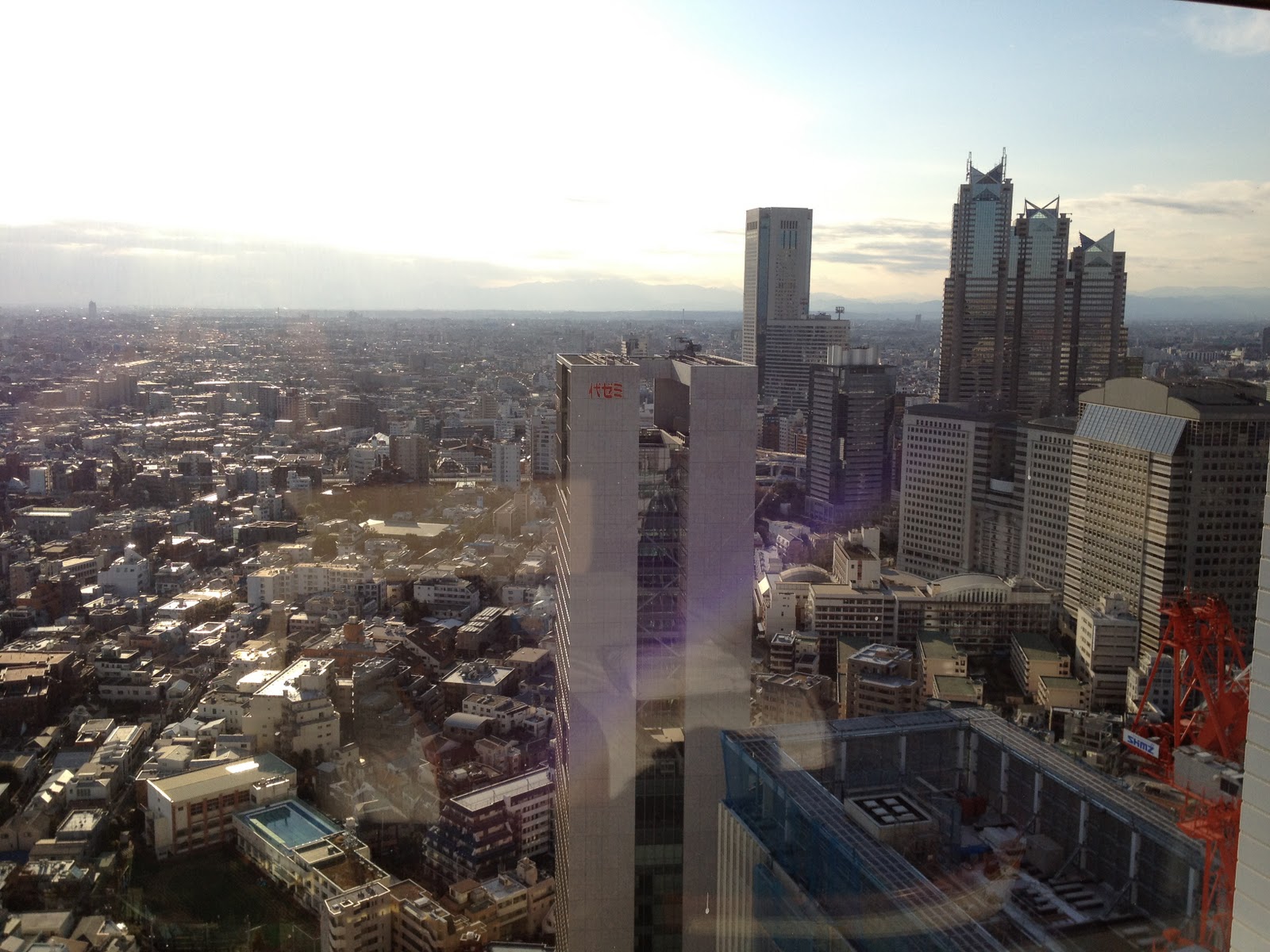
    I'd have to be a much better photographer — and have a much better camera than this iPhone — to do justice to the view from my room, here on the 35th floor of the Century Southern Tower in Shinjuku. I don't think I've ever seen anything like it. I've lived high up in London, and even a view which includes the Swiss Re and the half-complete Shard (like the background to my about.me page) pales against this sea of lights spreading far away to the horizon. The black void in the picture below is the Yoyogi Park surrounding the Meji Shrine.


    By day the view is equally impressive. The annotated cityscape next to the window here tells me that that's Mount Fuji hidden behind the clouds in the distance there.


    Since I'm being kept awake by jetlag — which sounds way cooler than my usual annoying insomnia — I'm going to note down my initial impressions of Tokyo while they're still fresh.
    • Everything you've heard about how courteous and polite the Japanese are is absolutely true. I've turned up here, unable to speak a word of their language — well, I guess I can manage three or four, but I always seem to forget them when the time comes — and so far everyone I've met has been extremely helpful. I was worried about how to get from Narita to my hotel, having a vague notion of which train to take and which type of ticket to buy, but a few moments in the JP Rail ticket office and problem solved. Also, the amount of signage and the number of announcements which are in English is unbelievably generous.
    • The thing where you hand over things — tickets, passports, cards — with both hands will take some getting used to.
    • As will the toilets. I swear the one in my hotel room has more functions than my phone.
    • Hats seem to be big over here.
    • If those guys in the Economy cabin with me weren't a small-time rock group hoping to make it big in Japan, I'd be very disappointed, even if it is an almighty cliche. They certainly had all the stereotypes covered — long-haired and goateed prog-rock guy; large, curly-haired metal dude; goth girl who wouldn't take off her kitten-eared hat even inside the plane; trendy-haired too-cool-for-school in his skinny jeans. I should've asked them where they were playing. But it's annoying, because now the thing I was planning to write is going to look even less original.
    • I took ages for my ears to pop. They didn't really clear until I started yawning. And every time I did, the city got a little bit louder.
    • Shinjuku station makes the Bank-Monument complex look like an underpass. I have already spent a confused hour 'exploring' it.
    • The "JP DOCOMO" carrier ident is so long that it forces the network activity spinner across onto the righthand side. Ugh.

    Thursday, January 05, 2012

    Comfort Zones

    The New Year is, I guess, as good a time as any to try something new — unoriginal, but at least everyone's doing it — so I'm about to step outside of my comfort zone.

    Maybe somebody could alert our Embassy over there. Thanks.

    Monday, January 02, 2012

    codeyear.com

    A link to codeyear.com has been doing the rounds on Twitter over the last couple of days. The idea is that you sign up for a weekly e-mail newsletter containing an interactive lesson which, over the course of the next year, will teach you how to code. (Before you ask: yes, I have signed up. It's all about the life-long learning, and the constant nagging feeling that I'm doing something wrong.) This prompted pieces from Brent Simmons — who quotes Douglas Rushkoff's "program or be programmed" from off the site (showing he has more restraint than me, who would instead have pointed out Paul Graham's rather unfortunate "invest two years ... to learn how to hack") — and Daniel Jalkut — who wonders whether aggregate programming ability could be used in a similar manner to literacy rates to measure a society's level of intellectual advancement.

    While yesterday I was hesitant to endorse the idea of making programming a part of the national curriculum, studied by all school children, I should point out that I don't have a problem with people learning to code. (Just as long as they aren't better than me. Or learn HTML+CSS mark-up and call it coding.) The more coders the better, I say. So if you want to program — if you've ever felt even the tiniest urge to create something in code — then you should give it a go, and this seems like the perfect way to get your feet wet.

    Sunday, January 01, 2012

    The JavaScript Turtle

    The state of computing and IT education in the nation's schools was a subject which came up several times at the couple of developers' conferences I attended this summer. At Update Conf, Anna Debenham's talk The Digital Native was a survey of current practices in teaching IT. I can't say I was particularly surprised that things haven't moved on much in the 20-or-so years since I was at secondary school. The roomful of Archimedes have been replaced with Windows PCs, but otherwise the curriculum, with its emphasis on doing pointless things in the name of learning to use a few productivity applications, seems the same.

    (Anna's talk was probably the most thought-provoking of those given at Update, if only because its unevenness meant it wasn't as polarising as those by certain other speakers. There was a lot there which I agreed with, along with too much I found ill-informed and irritating for whatever reasons. All of which is, I guess, the mark of an excellent conference speaker.)

    The basic preoccupation for attendees — a good number of whom were developers, even though Update itself had a far broader mix of professions represented — was whether the teaching of IT in schools should include programming. Later that week, at iOS Dev UK in Aberystwyth, Fraser Spears, during the Q&A portion of his talk on the deployment of iPads to school kids he's been overseeing, was asked this specific question. His reply — which I find myself wholeheartedly agreeing with — was that general IT education should engender an interest in computing such that a child may be inspired to take up programming, but programming itself should only be an optional part of the curriculum.

    My agreement is probably due to the fact that I came to programming on my own, without ever meeting it at school. There was a myth among my year — which may have been true, I have no real way of checking — that up until only a couple of years previously, programming had been generally taught, and that we had only just missed out. I don't know what affect being taught programming would have had on me. Maybe it would have crushed any enthusiasm I felt for the subject. Apart from at A-Level, I have no academic programming experience, but I like to think that, more important that teaching myself how to program, was teaching myself how to teach myself to program.

    Anyway, all of this talk of education got me to thinking about those old stalwarts of teaching kids about computers: Logo and the turtle. I can't remember for sure whether I ever met these two (I have vague memories of a BBC Micro and a primary school classroom, but I may be inventing those...), but I've never really got on with Lisp. Whatever its educational benefits, its hardly a mainstream language these days, and if we're going to introduce school children to programming it may as well be in a language they can conceivably take forward into a career. So without further ado, I present the JavaScript Turtle.

    The JavaScript Turtle is my first attempt at implementing a turtle in javascript (hence the deceptive name). As will become apparent by examining the source, I'm really not a web guy. Nevertheless, I have a soft spot for javascript, and I think that web technologies are an ideal playground for introducing the next generation of hackers to the wonders of code. The more perceptive among you will realise that what we're giving the young user here is a environment which allows them to execute arbitrary javascript — not just turtle control code — within the page. It's a massive, but basically safe, new world for the more inquisitive to explore.

    My intention was to have the whole thing — markup, styles and code — encapsulated in a single file, so even if your school network is locked down, you can still distribute it the old fashioned way (which in my mind means floppies, although I've no idea if even our decrepid UK schools still support them). I intend to continue working at this — in particular, I need to add the ability to parse and handle control statements in a smart way — so if this is of any use to anyone, let me know.

    Saturday, December 31, 2011

    Knights

    Given the delightful news of Jony Ive's ennoblement, I guess we should brace ourselves for a chorus of WTFs — most originating, more than likely, from a certain errant former colony over yonder westwards — decrying as anachronistic the British honours system. But to do so is to misunderstand the very important role which Knights — and, of course, Dames — play in matters of National Security. Let me explain.

    Traditionally, the role of a knight has been to act as advisor to the monarch and, during times of war, as an ad hoc general. Much like Jedi, only with a better chance of getting a table at the Ivy. There were many other duties performed as well, mostly involving Questing and rescuing princesses from eg. dragons, orges, trolls, less-attractive family members, etc.. The low number of minor royals being abducted by mythical creatures over recent years attests to what an excellent deterrent the Honours System continues to be. But while still important, these knightly duties are receiving less attention these days. For instance, during the Knight Camp training session in the Scottish Highlands which all the newly elevated must attend, only a single day is now given over to jousting (although this is still fairly intensive, covering as it does not only traditional horse-back jousting, but also jousting on motorbike — both standard and with sidecar — and while hung out of the window and / or sunroof of a wide selection of motor vehicles). The role of the modern knight is that of inspirational figurehead.

    Once upon a time, a knight's place on the battlefield was right in the thick of things. This wasn't a bad thing for your average knight, since the excess cash which came with his privileged position would allow him to invest in the latest greatest kit. So while everyone else had only particularly crusty sackcloth to protect them from the business end of a bec de corbin, the knight, encased as he would have been within state-of-the-art tincannery, was free to wander about at his leisure, guisarmes and voulges bouncing off him like gentle spring rain. The advent of the professional soldier was responsible for killing off the gentlemanly sport of Amateur War. Blame ol' wart-face Cromwell. What it meant to be a knight had to change with the times.

    The wars of the future won't be fought in the traditional manner. But don't go getting all excited. The wars of the future won't be fought in what we used to call CyberSpace, either. No, the wars of the future will be fought on home ground, in shopping centres, car parks and chain restaurants, against zombies or aliens — or, in one particular nightmare scenario, zombie aliens. It is these wars which your modern knight is being equipped to lead. Their role is to shape whatever ragtag group of disparate survivors they stumble upon into a unstoppable fighting machine. Imagine the scene: A church hall, sometime after dark. A handful of villagers shelter inside, while outside they can hear their former neighbours shuffling around and professing their very real desire to consume brains. A door opens. Who can it be? Only bloody Sir Michael of Caine, that's who. "Alright, lads," says he. "I know we're in a bit of a spot, but don't worry, I've got a plan." Game over for Johnny Zombie.

    Seriously, Rest Of The World, when the alien motherships are hovering over our capital cities, who will you have to turn to? Politicians? Celebrities? Mouseketeers? Because we'll have Captain Picard and Gandalf.

    Wednesday, December 28, 2011

    Lexical: A Retrospective

    Since it's coming to the end of the year and I'm feeling a little nostalgic, I thought I'd revisit Lexical, the first iOS code I ever snuck into the App Store. This was released back in the heady halcyon days of October 2009, and since then has been downloaded literally dozens of times.


    The visual style is minimalist, inspired by Bauhaus. I like to think that it had a direct influence on the design of the Windows Phone 7 / Windows 8 Metro UI, but then I'm prone to vast delusions of grandeur. Whatever, it's probably long past due a bit of a revamp.

    I originally wrote Lexical in a couple of weeks, mainly so I could experiment with Core Animation layers. This time I'll be using Cocos2D/3D for the same reason. And since I've already worked out all the tricky game logic stuff, it should take far less time.

    (Why, yes, those do sound an awful lot like famous last words to me.)